 | |
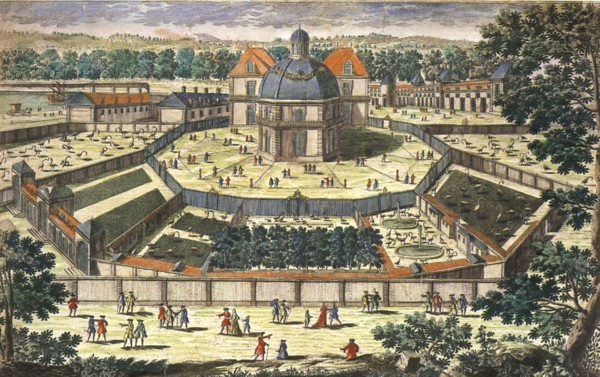
| The Versailles Menagerie- 17th Century Coloured Copperplate Print |
The first of these pairs- Mastery-Harmony- is easy enough to understand. On the one hand zoos have been traditionally spaces that display mankind's dominance over the natural world through the containment of wild beasts behind cages. During the late medieval period and onwards, the monarchies of Europe owned illustrious menageries populated with all manner of animals, both domestic and 'exotic'. For a time, even the infamous Tower of London was the site of Henry VIII's personal zoo. Then, as Milstein explains, "European colonists [in the New World]... brought with them a mastery-oriented way of seeing and acting upon the human place in the natural world."
In other words, western Rationalist thought places mankind as the most important power on the planet. As Europe colonized the world, the Europeans brought symbols of this ideology with them. And one such symbol is the zoo.
However, as Milstein puts it
[there also was] a countertheme within mainstream Western discourse, one made familiar in the late eighteenth century and nineteenth century writings of Thoreau, Emerson, and Whitman in the USA and of Wordsworth in England, that of valuing harmony with nature married to the belief that industrial progress threatens to disrupt such harmony.
This idea of harmony lends itself to notion of the zoo as a site of the preservation of the natural world.
I would argue that the other two dialectics each find their origin in this first binary opposition. The Mastery philosophy, by positioning man at the apex of the natural world gives rise to both the idea of nature as an alienated 'Other,' as well as justifying the ability to exploit it. We see both of these discourses written in to the zoo. The former discourse is easy to see in the way animals are kept in enclosures, to keep them away from the zoo patrons. This makes an Other, and clearly delineates the boundary between both parties in a physical way. At the same time, these enclosures are built to allow us humans the ability to voyeuristically observe the animals. We exploit these animals for our own visual pleasure. We can justify all of this by reminding ourselves that humanity has mastery over the natural.
Conversely, others could just as easily apply the harmony philosophy to their experience at the zoo. Rather than see the enclosures as static boundaries, many go right up to the animals in question to try and see if they can get its attention. This is not to tease the animal. Often the zoo patron want to communicate and forge a bound of some kind to the animal. In this way, Milstein argues, zoos can also be places of Connection to nature, providing close encounters that would be otherwise impossible. All of this is caught up in an air of Idealism, and Idealism that sees the zoo as a positive space. Those who subscribe to this Idealism relate to animal in an altruistic- rather than Exploitative- way. This cannot be possible without one possessing some sense of harmony with nature.
Although Milstein only applies these sets of dialectics towards the experience of a zoo, I argue that one can easily extrapolate these concepts to other forms of 'eco-tourism'. Next time you find yourself visiting some unfamiliar environment, interrogate your motives. Are you climbing that mountain simply because it's another challenge to overcome, or are seeing it as a way to grow a deeper understanding of your place in nature? You could be photographing those birds because they are exotic fauna to fetishize. Conversely, you may have forged an emotional connection to them, and those pictures are there to memorialize that experience. You could easily see that tropical sunrise as a purely visual pleasure, there for you to exploit, but you could just as easily contemplate the deeper meanings and loftier ideals that drive you to that experience.

No comments:
Post a Comment